


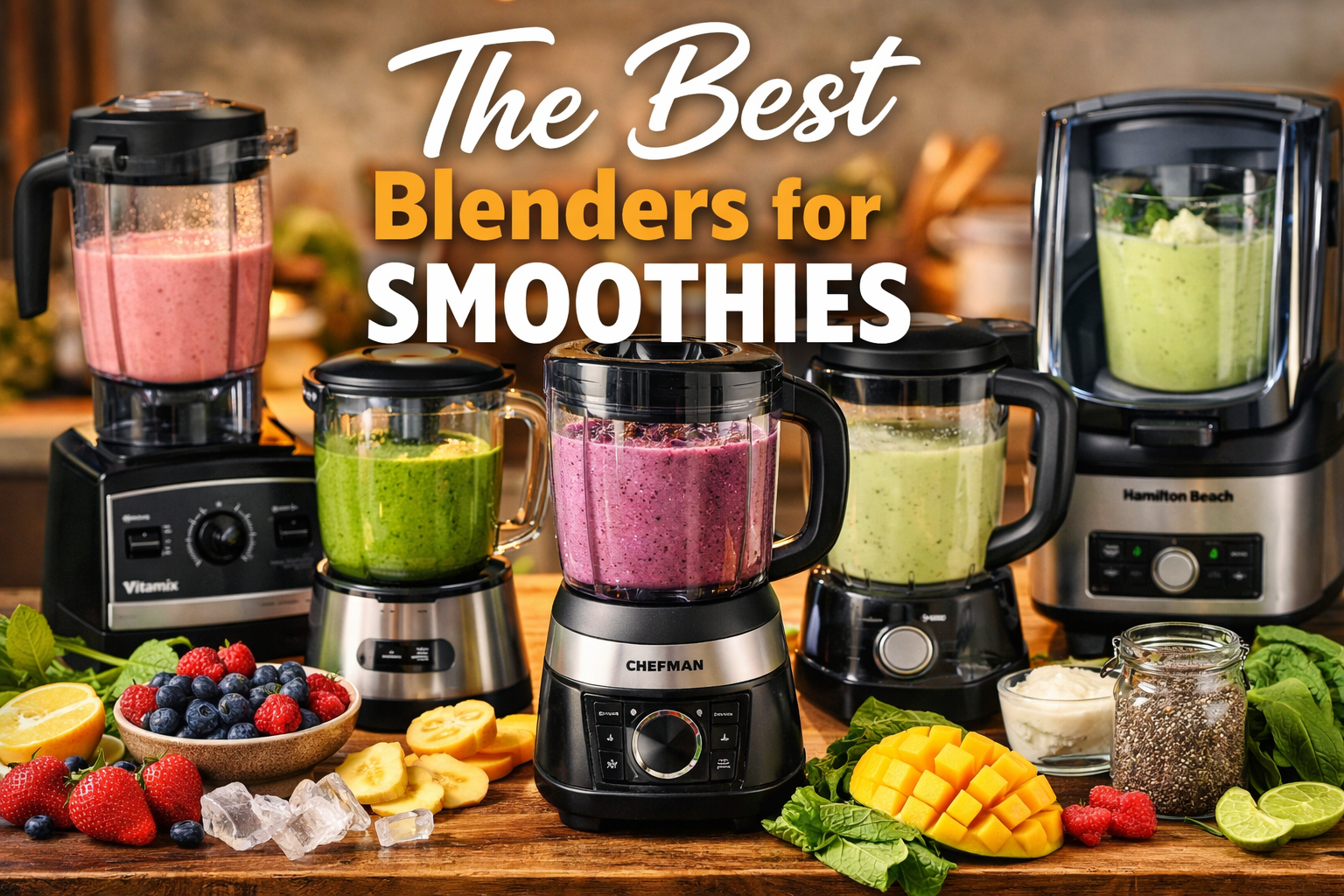
Smoothies are one of the easiest ways to add fruits, leafy greens, and protein into your daily routine. Whether you drink a quick banana shake in the morning or a frozen berry smoothie after a workout, the quality of your blender plays a major role in texture, taste, and consistency. A weak blender often leaves chunks of ice, fibrous kale strands, or unevenly blended fruit, which can ruin the experience.
The best blenders for smoothies are designed to handle frozen ingredients, ice cubes, and tough greens while still producing a smooth, drinkable result. Beyond power, jar design, blade speed, and ease of cleaning also matter—especially if you plan to use the blender daily. Some models excel at large family batches, while others are better suited for single servings or quieter kitchens.
In this guide, we’ve selected blenders that consistently deliver smooth results, are practical for everyday use, and offer good long-term value. Whether you want a premium all-rounder or a budget-friendly option, this list will help you choose the right smoothie blender with confidence.
Quick Picks:
| Best For | Product Name | Check Price |
|---|---|---|
| Best Overall | Vitamix Explorian E310 | Amazon↑ |
| Best Mid-Range | Braun TriForce Power Pro JB9041BK | Amazon↑ |
| Best Budget | Chefman Obliterator | Amazon↑ |
| Best Cheap | Black+Decker Quiet Blender (Cyclone Glass Jar) | Amazon↑ |
| Best Quiet | Hamilton Beach Professional Quiet Blender | Amazon↑ |
Vitamix Explorian E310 (Best Overall)
The Vitamix Explorian E310 is widely regarded as one of the most reliable blenders for smoothies, and for good reason. It is built to handle frozen fruit, ice, and fibrous greens without slowing down or overheating. The powerful motor works together with a carefully designed jar to create a strong vortex that continuously pulls ingredients toward the blades.
In terms of primary specifications, the Explorian E310 comes with a medium-capacity jar that works well for both single servings and family-size batches. Instead of preset programs, it uses a variable speed dial, allowing you to gradually increase blending speed. This control is especially useful when blending leafy greens or thick smoothies, as it helps avoid air pockets and uneven textures.
Using the blender is straightforward. You simply add liquid first, followed by fruits, greens, and ice, then slowly increase the speed until the smoothie becomes fully smooth. For thicker blends, the included tamper helps push ingredients back toward the blades without stopping the machine.
The main benefit of the E310 is consistency. Smoothies come out creamy, even when using tough ingredients like kale stems or frozen mango. From a real-world usage perspective, it performs equally well for quick morning smoothies and larger batches for families. The downside is noise—it’s loud—but that’s typical for high-performance blenders.
Braun TriForce Power Pro JB9041BK (Best Mid-Range)
The Braun TriForce Power Pro JB9041BK offers strong smoothie performance at a more approachable price than premium models. It is designed for users who want reliable blending power along with modern convenience features.
This blender includes a large main jar, making it suitable for preparing multiple servings at once. It also offers preset blending programs, which is helpful if you prefer one-touch operation. In everyday use, it handles frozen fruit and ice well, producing smooth smoothies with only minor texture left behind when blending fibrous greens.
To use it effectively, add liquids first, then ingredients, and select the smoothie preset or a higher speed. The presets automatically stop the blender, which is convenient for hands-free blending. The benefits include good performance, larger capacity, and user-friendly controls.
From a real usage perspective, this blender is well suited for families or meal prep. However, cleaning can take slightly longer because of the jar design and non-removable blades. Overall, it’s an excellent mid-range option for consistent smoothie making.
Chefman Obliterator (Best Budget)
The Chefman Obliterator proves that you don’t need to spend a lot to get smooth smoothies. Despite its lower price, it performs impressively with frozen fruit and ice.
Its primary specifications focus on simplicity and power for everyday blending. The jar size is practical for most smoothie needs, and the controls are easy to understand. When used correctly—liquid first, then fruit and ice—it produces a smooth texture suitable for daily drinking.
The main benefit of the Chefman Obliterator is value. It handles smoothies reliably and is easier to clean than many blenders in its price range. In real-world use, it’s ideal for users who mainly blend smoothies and don’t need advanced features or thick-mixture performance.
It’s not designed for nut butters or very thick blends, but for smoothies, it delivers more than expected for the price.
Black+Decker Quiet Blender with Cyclone Glass Jar (Best Cheap)
The Black+Decker Quiet Blender with Cyclone Glass Jar is aimed at buyers who want the lowest possible price while still making decent smoothies.
This blender comes with a sturdy glass jar and basic speed controls. It works best with soft fruits and moderate amounts of ice. When used for small batches, it can produce a reasonably smooth texture, though it doesn’t match higher-end models.
The key benefit is quiet operation compared to many full-size blenders. From a usage standpoint, it’s suitable for occasional smoothies rather than daily heavy use. Build quality is basic, but acceptable for the price.
Hamilton Beach Professional Quiet Blender (Best Quiet)
The Hamilton Beach Professional Quiet Blender is designed for users who prioritise low noise. It includes a sound-dampening cover that significantly reduces blending noise.
In terms of specifications, the jar is smaller than typical full-size blenders, but it still handles frozen fruit and ice effectively. To use it, you blend as usual, though thicker smoothies may require brief pauses.
The benefit is clear: quieter operation without sacrificing smoothie quality. In real-world use, it’s ideal for apartments or early-morning blending. The trade-off is limited capacity.
Comparison Table:
| Blender | Best For | Smoothness | Noise Level |
|---|---|---|---|
| Vitamix Explorian E310 | Overall Performance | Excellent | Loud |
| Braun TriForce Power Pro | Value & Batches | Very Good | Loud |
| Chefman Obliterator | Budget Smoothies | Very Good | Moderate |
| Black+Decker Quiet Blender | Lowest Price | Good | Quiet |
| Hamilton Beach Quiet Blender | Quiet Use | Very Good | Very Quiet |
How We Researched & Chose
We focused on real-world smoothie performance rather than marketing claims or wattage numbers alone. Each blender was evaluated based on its ability to break down frozen fruit, ice, and leafy greens into a smooth texture. Jar design, blade efficiency, and ingredient circulation were key factors in our assessment.
We also considered daily usability, including ease of cleaning, control layout, and noise level. Blenders that required frequent stopping, stirring, or complicated cleaning scored lower. Long-term value and reliability were prioritised, as smoothie blenders are often used daily.
This approach allows you to link to previous comparison or “Best” posts internally, helping readers explore related guides and strengthening site structure.
Buying Guide
When choosing a blender for smoothies, start with capacity. Smaller jars work better for single servings, while larger jars suit families. Blade speed and jar shape matter more than raw motor power, as they directly affect smoothness.
Noise level is important if you live in a shared space. Cleaning ease should also be considered—dishwasher-safe parts can save time. Finally, think about versatility. If you only make smoothies, a budget model may be enough. For soups or sauces, a more powerful blender is a better choice.
Final Recommendation
If you want the best overall smoothie experience, the Vitamix Explorian E310 remains the top choice for consistent, ultra-smooth results. For a more affordable option with strong performance, the Braun TriForce Power Pro is an excellent mid-range pick. Budget-focused users will appreciate the Chefman Obliterator, while noise-sensitive users should consider the Hamilton Beach Professional Quiet Blender.
Frequently Asked Questions
Are blenders for smoothies different from regular blenders?
Yes, blenders designed specifically for smoothies usually perform better than basic or low-powered regular blenders. Smoothie blenders are built to handle frozen fruit, ice, and fibrous ingredients like kale or spinach. They typically have faster blade speeds, better jar designs that create a strong vortex, and motors capable of maintaining consistent power under load. Regular blenders may mix soft fruits well but often struggle to fully break down ice or leafy greens, resulting in chunky or gritty smoothies.
Is higher wattage always better for smoothies?
Not always. While higher wattage can help, it doesn’t guarantee better smoothie results on its own. Jar shape, blade design, and blade speed play an equally important role. Some blenders with moderate wattage perform exceptionally well because their jars keep ingredients circulating efficiently. A well-designed blender with balanced power often produces smoother smoothies than a high-wattage blender with poor airflow or blade geometry.
What ingredients should go in first when making a smoothie?
The best order is to add liquids first, followed by soft ingredients like yogurt or fresh fruit, then leafy greens, and finally frozen fruit or ice. Starting with liquid helps the blades spin freely and prevents ingredients from getting stuck. Adding frozen items last also helps push lighter ingredients down toward the blades, resulting in a smoother and more consistent blend.
Can smoothie blenders handle ice and frozen fruit?
Yes, good smoothie blenders are specifically designed to handle ice cubes and frozen fruit. High-quality models can crush ice evenly and blend frozen berries without straining the motor. However, cheaper or low-powered blenders may require smaller ice portions or extra liquid to avoid uneven blending. For best results, always add ice gradually and avoid overfilling the jar.
How long should you blend a smoothie?
Most smoothies are fully blended within 30 seconds to 2 minutes, depending on the blender and ingredients used. High-performance blenders often achieve smooth results faster, while budget models may need slightly longer blending time. Blending for too long can heat the ingredients and affect taste, so it’s best to stop once the texture is smooth and consistent.